We started paying attention to nitric oxide for a simple reason: our resting blood pressure was climbing. Nothing alarming, but the trend was clear. One of our team members went from a consistent 118/76 to 128/84 over three years, eating the same, exercising the same. The usual explanation is "that's just aging." We weren't satisfied with that answer.
After six months of reading the research and running our own protocol, we understand what actually changed and why NO supplementation became a permanent part of our stack. This is everything we learned, without the hype.
Quick Summary
- Nitric oxide declines with age due to reduced eNOS activity and rising ADMA levels - not lifestyle alone
- L-citrulline outperforms L-arginine for raising plasma arginine because it bypasses first-pass metabolism in the gut
- Beet root extract adds a second pathway - dietary nitrates convert to NO independently of the eNOS enzyme
- Results take 4-8 weeks for blood pressure changes; exercise performance improves faster
- Anyone on BP medication should monitor carefully - the combo can work too well
What Nitric Oxide Actually Does
Nitric oxide is a gas produced in the lining of your blood vessels, the endothelium, by an enzyme called endothelial nitric oxide synthase (eNOS). When it's produced, it diffuses into the smooth muscle layer of the vessel wall and signals it to relax. That relaxation widens the vessel, reduces resistance, and lowers the pressure your heart has to work against.
That's the cardiovascular basics, but NO does more. It improves oxygen delivery to muscles during exercise, which is why it's been a staple in sports nutrition long before the longevity crowd caught on. It regulates platelet aggregation, reducing the stickiness of blood cells and the tendency toward clotting. It plays a role in insulin sensitivity, brain blood flow, and - less politely discussed but worth stating - erectile function, which is one of the cleaner early warning signs of endothelial health in men.
When NO production falls off, you don't necessarily feel a dramatic change. You feel a slow accumulation of "less": less exercise capacity, slightly higher blood pressure, slower recovery, less mental sharpness on high-demand days. The kind of thing most people attribute to getting older and leave at that.
Why It Declines After 40
There are two main mechanisms, and they compound each other.
First, eNOS activity decreases with age. The enzyme is still present, but it becomes less efficient. Part of this is oxidative stress: reactive oxygen species produced in aging tissues compete with NO and neutralize it before it can act. The net result is lower bioavailable NO even when production technically continues.
Second, a compound called ADMA (asymmetric dimethylarginine) rises steadily with age. ADMA is a direct competitor to L-arginine, the amino acid eNOS uses as its raw material. It sits in the same binding site on the enzyme and blocks it from processing arginine into NO. Elevated ADMA is strongly associated with cardiovascular risk in the research literature and is measurable with a standard blood test if you want a baseline.
The practical implication is that the problem isn't just "I need more arginine." You need to flood the system enough to overcome ADMA competition, and you need to do it in a way that actually reaches the endothelium rather than getting degraded before it gets there.
The Arginine vs. Citrulline Question
For years, L-arginine was the default supplement for NO support. The logic seemed obvious: arginine is what eNOS converts to NO, so give it more arginine. The problem is pharmacokinetics. Oral L-arginine is heavily metabolized in the gut and liver before it reaches systemic circulation. Doses of 3-6g might raise plasma arginine modestly. Doses above 10g cause GI distress in most people before you get meaningful absorption.
L-citrulline changes the math. Citrulline is found naturally in watermelon (the name comes from Citrullus lanatus, the botanical name) and isn't metabolized in the gut. It travels intact to the kidneys, where it's converted to arginine and released into circulation. This produces a more sustained and higher peak plasma arginine level than taking arginine directly - which, when you first encounter it, sounds absurd. Taking the precursor outperforms taking the end product. But that's what the research shows consistently.
A 2016 meta-analysis in the European Journal of Nutrition confirmed that citrulline supplementation increases plasma arginine more reliably than L-arginine supplementation at equivalent doses. Multiple studies in older adults with mild hypertension have shown 4-8 week reductions in systolic blood pressure of 4-15 mmHg at doses of 3-6g of citrulline daily. For our team member who started at 128/84, that's a meaningful range.
The Dietary Nitrate Pathway
There's a second, completely separate route to NO production that doesn't involve eNOS at all. Dietary nitrates from vegetables like beets, spinach, arugula, and celery are converted to nitrite by bacteria in your saliva, then further reduced to NO in the stomach and bloodstream, particularly under low-oxygen conditions like during exercise or sleep.
This is why beet root extract appears in most serious NO-focused supplements. It targets a pathway that works independently of eNOS efficiency, which means even people with significant endothelial dysfunction can benefit. A 2015 study in Hypertension found that 250ml of beet root juice daily reduced systolic blood pressure by an average of 8 mmHg over four weeks. The active nitrate content in standardized beet root extract supplements allows you to hit similar doses without drinking a glass of beet juice every morning.
Combining citrulline with beet root extract gives you both pathways simultaneously. That's the formulation logic behind most of the better NO supplements on the market.
What We Actually Added to Our Stack
After testing several formulations, we settled on Pure Encapsulations Nitric Oxide Ultra as our primary recommendation. Pure Encapsulations is one of the few supplement brands that publishes third-party testing results and maintains NSF certification, which matters when you're taking something daily. Their Nitric Oxide Ultra formula targets both the L-arginine/eNOS pathway and the dietary nitrate pathway, which matches exactly what the research supports.
The brand's broader commitment to clean formulation - no unnecessary fillers, no artificial flow agents, pharmaceutical-grade sourcing - is consistent across their line. If you're going to spend money on a NO supplement, spending it on one you can actually trust the label of is the right call.
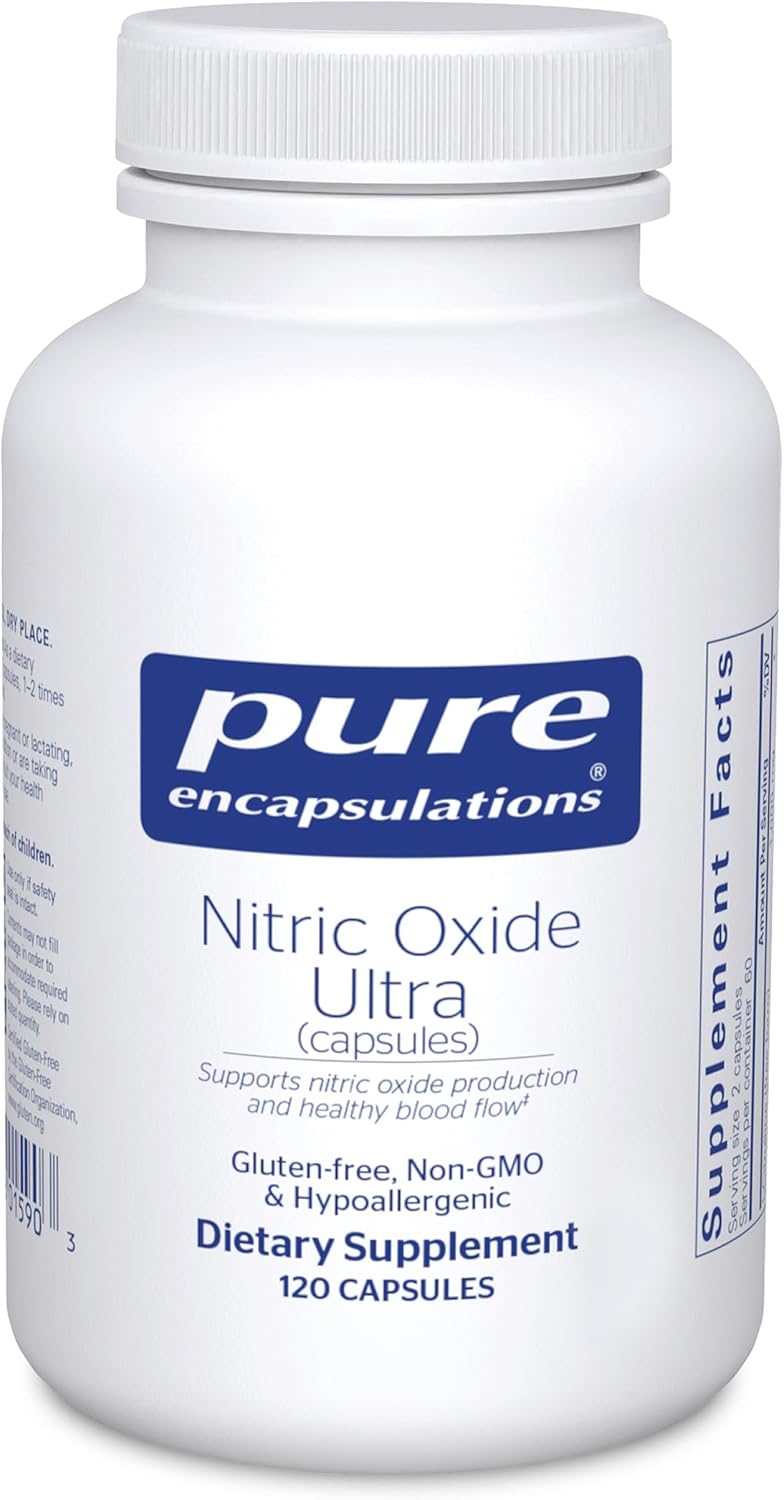
Pure Encapsulations Nitric Oxide Ultra
Dual-pathway NO support - clean formulation, third-party tested
$49.90
Check Price on Amazon →What to Expect and When
Here's what our team actually noticed, and roughly when:
Week 1-2: Workouts
The exercise performance effect showed up first. Training felt slightly different - harder to explain than it sounds, but the "pump" during resistance training was noticeably better, and recovery between sets felt cleaner. This tracks with the research: improved muscle blood flow during exercise is one of the fastest effects of acute NO support.
Week 3-4: Sleep and Morning Energy
A couple of team members reported waking up feeling more rested. We attribute this to improved blood flow during sleep, when the body does most of its repair work. The effect was subtle but consistent enough that multiple people mentioned it independently before we started comparing notes.
Week 6-8: Blood Pressure
This is where it got interesting. The team member who started the protocol specifically to address creeping blood pressure saw his readings drop from averaging 128/84 to 121/79 over eight weeks. He changed nothing else during that period. We're not calling it a clinical cure - we're calling it a data point that matches what the peer-reviewed literature predicts, which is all we can honestly say.
A Note on Who Should Be Careful
If you're already on blood pressure medication, NO supplementation can lower your numbers further than intended. That's not necessarily bad, but it means working with your prescribing doctor and monitoring your readings more frequently during the first few weeks. The interaction is additive, not dangerous per se, but it's real.
High-dose L-arginine (not citrulline) can potentially trigger herpes simplex outbreaks in people who are susceptible, since arginine supports viral replication. Citrulline-based formulas don't carry this same risk to the same degree, but it's worth knowing if you have a history of cold sores and are considering supplementation.
Otherwise, the safety profile of citrulline and beet root extract is clean. These aren't aggressive compounds. They work with a mechanism your body already has, they just support it more effectively than the aging endothelium can do on its own.
The Bottom Line
Nitric oxide is one of those mechanisms where the science is genuinely clear, the supplements that target it are relatively inexpensive, and the downside risk is low. It's not a dramatic intervention - it's a quiet, consistent improvement to how your cardiovascular system functions at a cellular level. For our team, that's exactly the kind of thing we're interested in. The results that accumulate slowly, over years, because they're actually changing something real.
If you've been watching your blood pressure trend upward and writing it off as inevitable, it may not be.
Pure Encapsulations Nitric Oxide Ultra
What we take for daily cardiovascular NO support
$49.90
Check Price on Amazon →Frequently Asked Questions
What is nitric oxide and why does it matter after 40?
Nitric oxide is a signaling molecule produced in your blood vessel walls that causes smooth muscle to relax, widening the vessels and improving blood flow. After 40, the enzyme that makes NO becomes less efficient, and a compound called ADMA accumulates that actively blocks production. The result: stiffer vessels, higher blood pressure, slower muscle recovery, and reduced oxygen delivery throughout the body.
Is L-citrulline better than L-arginine for boosting nitric oxide?
Yes, for most people. L-arginine is broken down in the gut and liver before it reaches the bloodstream, so only a fraction of an oral dose reaches your endothelial cells. L-citrulline bypasses this first-pass metabolism, converts to arginine in the kidneys, and raises plasma arginine levels more reliably. Most current research on blood pressure and exercise performance now favors citrulline over arginine.
How long does it take to see results from nitric oxide supplements?
Exercise performance and muscle pump effects can be noticeable within one to two weeks of consistent use. Blood pressure improvements take longer: most studies showing meaningful reductions ran 4-8 weeks. Endothelial function changes measured by flow-mediated dilation typically require 4-6 weeks to show up measurably.
Can diet alone raise nitric oxide levels?
Diet contributes meaningfully. Foods high in dietary nitrates (beets, spinach, arugula, celery) are converted to NO via a separate bacterial pathway in the mouth and gut. But dietary nitrates don't fully replace the L-arginine/eNOS pathway, especially in older adults with compromised endothelial function. Combining dietary nitrates with citrulline supplementation targets both pathways simultaneously, which is why the best formulations include both.
Is nitric oxide supplementation safe long term?
L-citrulline and beet root extract have good safety profiles in the research literature. People on blood pressure medications should monitor closely and discuss with their doctor, since the combination can lower blood pressure more than intended. Otherwise, these are well-tolerated compounds working with a mechanism your body already uses - they're supporting a process, not forcing one.