Here at iVitaLab, we get this question constantly: should you switch from ubiquinone to ubiquinol - and does it actually matter? Most people start with a standard $14 bottle of ubiquinone CoQ10 from the grocery store, often after a cardiologist mentions it alongside a statin prescription. After months of research and testing across our team - including a close look at the pharmacokinetic data - we went deeper into the absorption differences between the two forms. The difference is real and meaningful for the right people. This article is what the iVitaLab team found.
Quick Answer: Which Form Do You Need?
- Under 40, no statins: Standard ubiquinone at 100 mg/day works fine. Save your money.
- Over 40: Your conversion efficiency has declined. Ubiquinol absorption is roughly 3x higher dose for dose.
- On a statin: Ubiquinol, full stop. Statins deplete CoQ10 at the synthesis level and you need maximum absorption.
- Cardiovascular concerns: Ubiquinol. The clinical data on blood pressure and cardiac output is specifically built on the active form.
- Budget is tight: A quality ubiquinone is still far better than no CoQ10 at all.
What Is CoQ10 and Why Does It Matter
Coenzyme Q10 is a fat-soluble compound synthesized in virtually every cell in your body. Its primary job is to sit in the inner mitochondrial membrane and shuttle electrons between the protein complexes of the electron transport chain. Without that shuttle, the chain stalls and your mitochondria cannot produce ATP efficiently. ATP is the energy currency your cells run on, and every process in your body from muscle contraction to cognitive function depends on an adequate supply of it.
CoQ10 also functions as a potent antioxidant, neutralizing free radicals generated during ATP production. The mitochondria produce a significant portion of your body's reactive oxygen species as a byproduct of energy metabolism. CoQ10 helps contain that oxidative damage directly at the source.
The problem is that your body's ability to synthesize CoQ10 peaks in your mid-twenties and then begins a steady decline. By age 40, tissue CoQ10 levels are measurably lower than at 25. By age 65, some studies show heart tissue CoQ10 levels have dropped by as much as 57% compared to young adults. That decline correlates with the fatigue, reduced exercise capacity, and slower recovery that most people assume are simply unavoidable parts of getting older.
Dietary sources help only marginally. You would need to eat roughly 0.5 kg of beef heart per day to match a 100 mg supplement dose. Supplementation is the practical route, which brings us to the question that actually matters: which form?
Ubiquinone vs Ubiquinol: The Core Difference
CoQ10 exists in two interconvertible forms. Ubiquinone is the oxidized form. It is the version you find in most inexpensive supplements and the form your body naturally synthesizes. Before ubiquinone can function in the electron transport chain, your body must first reduce it to ubiquinol, the active form. Ubiquinol is also the primary form circulating in your blood, where it serves as an antioxidant.
When you are young and healthy, that ubiquinone-to-ubiquinol conversion happens efficiently. Your enzymes handle it without much loss. The conversion relies on a process called enzymatic reduction, and enzyme activity is generally robust before age 40.
After 40, enzymatic conversion efficiency drops. Oxidative stress increases with age, which means more of your circulating CoQ10 ends up in the oxidized (ubiquinone) state rather than the active (ubiquinol) state. Some studies put the efficiency decline at 40 to 50% by your fifties compared to your twenties. When you supplement with ubiquinone at that stage, a meaningful portion of what you swallow never completes the conversion to the form your cells actually need.
Ubiquinol supplements bypass that conversion step entirely. You absorb the active form directly. A 2009 pharmacokinetic study published in the Journal of Clinical Biochemistry and Nutrition found that ubiquinol produced plasma CoQ10 concentrations approximately 4.7 times higher than the same dose of ubiquinone in elderly subjects. In healthy middle-aged adults, the advantage is typically described as 2 to 3 times higher bioavailability. That gap is the entire argument for paying the premium.
Ubiquinone vs Ubiquinol at a Glance
| Factor | Ubiquinone | Ubiquinol |
|---|---|---|
| Form | Oxidized (inactive) | Reduced (active) |
| Bioavailability | Baseline; requires conversion | ~2-4x higher; no conversion needed |
| Age Suitability | Best under 40 | Preferred over 40; essential over 55 |
| Price (100 mg/day) | ~$0.15 to $0.25/day | ~$0.40 to $0.65/day |
| Best For | Young adults, budget-conscious, no statin use | 40+, statin users, cardiovascular support |
The Supplement We Recommend
After doing the research, the iVitaLab team landed on Qunol Ubiquinol CoQ10. The reason is partly the form (ubiquinol, as discussed) and partly the formulation. Qunol uses a patented water- and fat-soluble delivery system. Most CoQ10 supplements are lipid-soluble only, which means absorption is heavily dependent on consuming fat in the same meal. Qunol's formulation is designed to absorb in both environments, which makes timing less of an issue and absorption more consistent across different days.
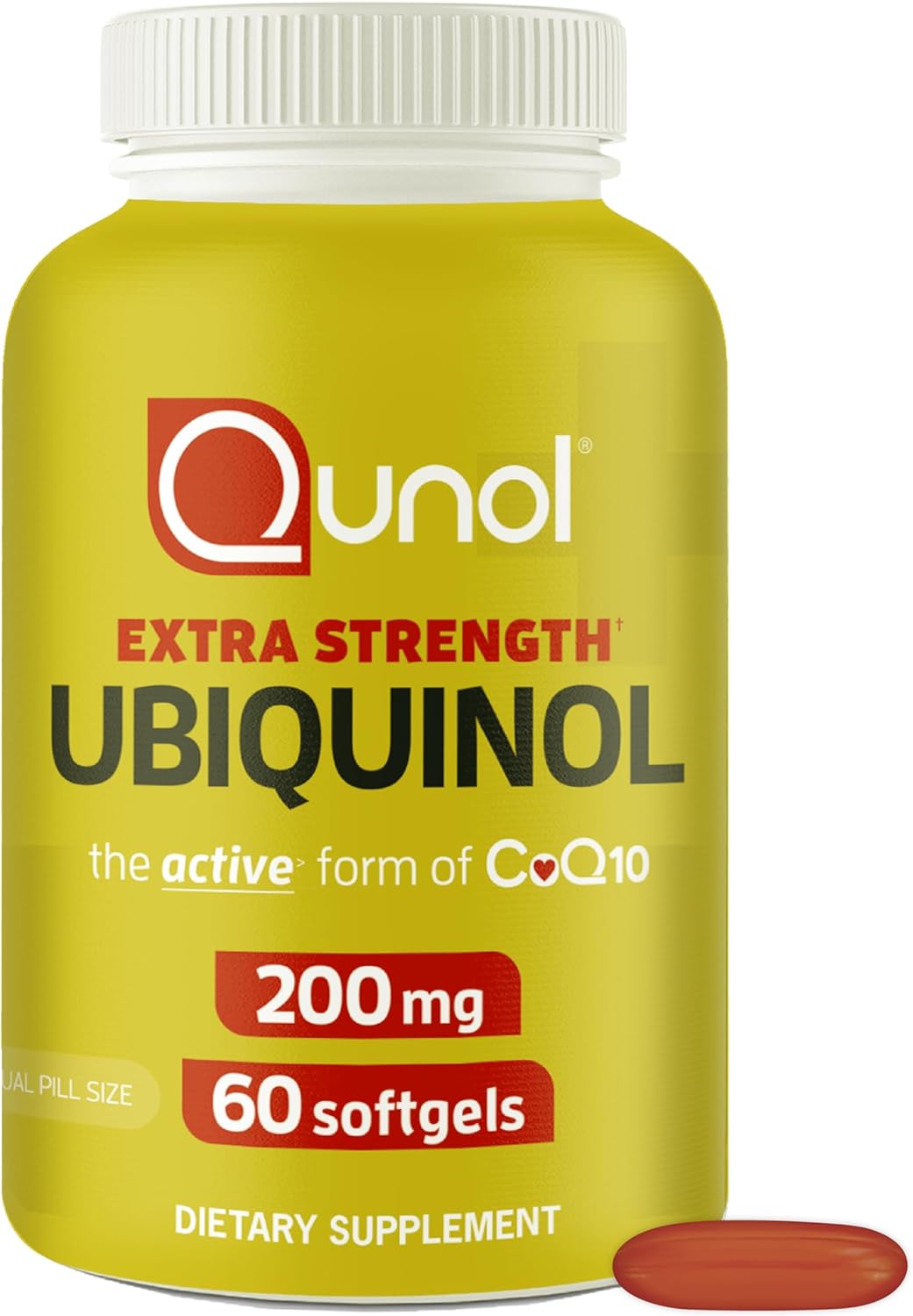
Qunol Ubiquinol CoQ10
100 mg Ubiquinol · Water & Fat Soluble · 60 softgels
~$35
Check Price on Amazon →At roughly $0.58 per day, it costs about $0.35 more per day than a generic ubiquinone. For someone in their forties on a statin, that math is simple. For a healthy 30-year-old, it is harder to justify. We will address that split directly in the next section.
Who Should Take Which Form
We want to be straightforward here rather than push everyone toward the pricier product. The right answer genuinely depends on your situation.
If you are under 40 and not on any statin or cholesterol-lowering medication: your enzymatic conversion of ubiquinone to ubiquinol is most likely efficient. A quality ubiquinone CoQ10 at 100 to 200 mg daily will produce adequate plasma ubiquinol levels. You do not need to pay double for a pre-converted form. Buy a quality ubiquinone brand with a lipid carrier (softgel, not a dry tablet) and take it with a meal containing dietary fat.
If you are over 40: the conversion efficiency argument starts to matter. The pharmacokinetic studies consistently show a widening gap in plasma CoQ10 levels between the two forms as subjects age. The exact crossover point varies by individual, but age 40 is a reasonable threshold where ubiquinol begins to offer a meaningful practical advantage over equal doses of ubiquinone.
If you are over 55: ubiquinol is the clear choice. Conversion efficiency at this age is significantly diminished in most people, and several clinical studies showing cardiovascular and cognitive benefits from CoQ10 supplementation in older adults used the ubiquinol form specifically.
If you have heart failure, cardiomyopathy, or other active cardiovascular conditions: the landmark Q-SYMBIO trial on CoQ10 and heart failure used 300 mg/day of conventional CoQ10, but subsequent research on cardiac output in older patients has focused on ubiquinol. Work with your cardiologist, but ubiquinol is generally the preferred form in cardiovascular contexts.
Statin Users: Pay Attention
Statins block HMG-CoA reductase, an enzyme that sits upstream in both the cholesterol synthesis and CoQ10 synthesis pathways. That means every statin user is actively depleting their endogenous CoQ10 production as a side effect of the medication. This is not a theoretical concern: studies measuring plasma CoQ10 in statin users consistently show 16 to 40% reductions depending on the statin type, dose, and duration.
Some common statin side effects, including muscle aches (myalgia), exercise intolerance, and fatigue, are plausibly explained in part by CoQ10 depletion and the resulting impairment of mitochondrial ATP production in muscle tissue. CoQ10 supplementation does not eliminate statin side effects for everyone, but the evidence for at least partial mitigation is solid enough that most cardiologists no longer dismiss it.
For statin users specifically: ubiquinol with 3x greater plasma absorption is not a nice-to-have, it is the obvious choice. A 100 mg ubiquinol dose at the absorption advantage effectively delivers what would require 200 to 300 mg of ubiquinone to match in an older adult. Qunol Ubiquinol is what the iVitaLab team recommends to anyone in this situation.
Stack It For Better Results
CoQ10 in isolation is useful, but it fits into a larger mitochondrial support picture. Two supplements we pair with ubiquinol that have direct mechanistic relevance:
Pair 1: NR (NAD+ Precursor) for Mitochondrial Energy
CoQ10 and NAD+ operate in the same mitochondrial energy production system. NAD+ is the coenzyme that feeds electrons into the electron transport chain, and CoQ10 shuttles those electrons down the chain to generate ATP. They are functionally complementary. As NAD+ levels decline with age (by roughly 50% between your twenties and fifties), the electron transport chain becomes less efficient regardless of CoQ10 levels. Raising NAD+ with a precursor like Pure Encapsulations NR Longevity and supporting the CoQ10 side of the equation simultaneously is a legitimate one-two approach to mitochondrial support. We recommend both.
Pair 2: TMG for Methylation Balance
If you add NR to your stack, Life Extension TMG becomes important. NR raises NAD+ by consuming methyl groups in the metabolic process, and depleted methyl groups can elevate homocysteine, which is an independent cardiovascular risk factor. TMG (trimethylglycine) donates methyl groups to restore that balance. Beyond the NAD+ pairing, TMG has its own data on homocysteine reduction and cardiovascular protection that is directly relevant for anyone with heart health concerns. At roughly $0.10 per day, it is one of the most cost-effective additions to a cardiovascular support stack.
Frequently Asked Questions
What is the difference between CoQ10 and Ubiquinol?
CoQ10 is the umbrella term for Coenzyme Q10. Ubiquinone is the oxidized, inactive form; ubiquinol is the reduced, active form. Your body converts ubiquinone to ubiquinol, but that conversion becomes less efficient after age 40. Supplementing with ubiquinol means you skip the conversion step entirely and absorb the active form directly.
Is Ubiquinol worth the extra cost?
For adults under 40 without statin use, probably not. Ubiquinone converts efficiently at that stage and costs significantly less. For people over 40, on statins, or with cardiovascular concerns, ubiquinol's roughly 3x absorption advantage over ubiquinone makes the premium worthwhile. At $0.58/day for Qunol Ubiquinol, the cost difference is about $12 to $15 per month over a quality ubiquinone product.
How long does it take for CoQ10 to work?
Plasma CoQ10 levels stabilize within 3 to 4 weeks of consistent daily dosing. Most people notice changes in energy and exercise recovery between weeks 4 and 8. The iVitaLab team noticed a meaningful difference in afternoon energy around week 6 after switching to ubiquinol. Blood pressure improvements in clinical studies typically emerge after 4 to 12 weeks at 100 to 200 mg/day.
Can I take CoQ10 while on statins?
Yes, and many cardiologists actively recommend it. Statins deplete CoQ10 through the same enzymatic pathway they use to block cholesterol. Supplementing with ubiquinol at 100 to 200 mg/day is the practical response. It does not interfere with the statin's mechanism. Check with your prescribing physician for your specific dose, but CoQ10 and statins are routinely used together.
What is the best CoQ10 supplement to take?
For adults over 40 or statin users: Qunol Ubiquinol CoQ10 is our top pick. The water- and fat-soluble formulation improves absorption consistency, and the ubiquinol form bypasses the conversion step. For younger adults without statin use, a quality ubiquinone softgel at 100 to 200 mg daily taken with a fat-containing meal is effective and considerably cheaper.
Related Guides
Best Vitamins for Longevity 2026: The Core Stack
Six supplements with the strongest evidence base for living longer and healthier.
D3 + K2: Why You Always Need Both Together
The calcium paradox explained and why D3 alone may be counterproductive.
Magnesium for Sleep: Citrate vs Glycinate vs Oxide
Which form actually works for sleep and why oxide is mostly useless.
Nitric Oxide Supplements for Cardiovascular Health 2026
Citrulline, beetroot, and arginine: what the evidence actually says.