When we started comparing bloodwork across our team, Vitamin D deficiency was the most common finding. What took us longer to understand was why taking D3 alone for years might actually create a problem. The calcium paradox - and K2's role in solving it - is the piece of this story that most people taking D3 supplements have never heard.
Quick Answer
- D3 increases calcium absorption - critical for bone density, immune function, and hormonal health.
- K2 (MK-7) activates proteins that direct that calcium into bones and teeth, not arteries.
- Without K2: excess calcium from D3 can calcify arterial walls - a cardiovascular risk factor.
- Best format: a combined supplement with both, or K2 taken with your D3 daily.
What Vitamin D3 Actually Does
D3 is technically a hormone precursor, not just a vitamin. Your skin synthesizes it from UV-B sunlight, and your liver and kidneys convert it into calcitriol, the active hormonal form. Calcitriol does several things: it upregulates calcium absorption in the gut significantly (from around 10-15% efficiency to 30-40%), activates gene transcription across hundreds of genes, and plays a central role in immune modulation and inflammation control.
About 42% of American adults are deficient, defined as serum 25(OH)D below 20 ng/mL. Many more are insufficient (20-30 ng/mL). The consequences of deficiency compound over decades: lower bone density, suppressed immune response, increased all-cause mortality in epidemiological studies, and higher rates of autoimmune conditions.
The reason so many people are deficient despite living outdoors is that modern life is mostly indoors, modern sunscreen blocks UV-B efficiently, and office windows block UV-B entirely. You can work in a glass building with sun streaming in and produce zero D3 from it.
The Calcium Problem D3 Creates
Here's where it gets complicated. D3 increasing calcium absorption is the intended effect for bone health. The problem is that calcium, once in circulation, needs to be directed somewhere. In a healthy system with adequate K2, it goes into bone matrix and teeth. Without K2, it circulates longer and has a higher chance of depositing in soft tissue.
The mechanism is well-documented: K2 activates two proteins critical to calcium regulation. Matrix GLA protein (MGP) is one of the most potent inhibitors of arterial calcification known. Osteocalcin is the protein that binds calcium into bone. Both require K2 to become active. Without K2, both remain in an inactive, uncarboxylated state.
Multiple studies in the past decade have found associations between low K2 status and higher rates of arterial calcification and cardiovascular events. The Rotterdam Study (nearly 5,000 participants, 7+ year follow-up) found that the highest K2 intake group had 57% lower risk of dying from coronary heart disease compared to the lowest. The relationship with K1 (the form in leafy greens) was not significant. It's specifically K2.
K1 vs K2: Understanding the Difference
This is a common point of confusion. Vitamin K1 (phylloquinone) is what you get from spinach and broccoli. It's primarily involved in blood clotting and is metabolized quickly. Most of it goes to the liver for clotting factor production.
K2 (menaquinone) has a longer carbon side chain that gives it a much longer half-life in the body and enables it to reach peripheral tissues - specifically, the arteries and bones. MK-4 is the shorter-chain form found in some animal products and certain supplements. MK-7 is the longer-chain form derived from natto (fermented soybeans) and is the form with the best evidence for cardiovascular and bone health due to its superior half-life of 72 hours versus MK-4's 4-6 hours.
When you're choosing a K2 supplement or a combined D3+K2, you want MK-7 specifically, at 100-200mcg per day.
How Much D3 Do You Actually Need?
This is highly individual, which is why bloodwork matters. The test you want is serum 25-hydroxyvitamin D, also written as 25(OH)D. Most functional medicine practitioners aim for 50-70 ng/mL as the optimal range for health and longevity. The standard clinical cutoff for sufficiency is 30 ng/mL, but that's a floor, not a target.
For most people who aren't regularly getting midday sun on significant skin area, 3,000-5,000 IU daily is a reasonable maintenance dose. People with higher body weight or malabsorption issues often need more. The only way to know for sure is to test after 8-12 weeks on a consistent dose.
| Serum 25(OH)D Level | Status | Typical Action |
|---|---|---|
| Below 20 ng/mL | Deficient | 5,000+ IU daily, retest in 8 weeks |
| 20-30 ng/mL | Insufficient | 3,000-5,000 IU daily |
| 30-50 ng/mL | Adequate (clinical) | 2,000-3,000 IU to optimize |
| 50-70 ng/mL | Optimal (functional) | Maintain current dose |
A Note on Blood Thinners
If you're taking warfarin (Coumadin) or other vitamin K antagonists, talk to your doctor before adding K2. These drugs work by blocking K2's role in clotting factor activation. K2 supplementation can interfere with their dosing. For everyone else, K2 at normal doses (100-200mcg MK-7) does not significantly affect blood clotting.
The Combined Supplement Case
You can take D3 and K2 separately. But there's a real practical advantage to combining them: you can't forget one. The whole point of the pairing is that they're taken together daily. A combined supplement removes that variable entirely.
Pure Encapsulations D3 & K2 is the one we use and recommend. The brand is clean (no unnecessary fillers), the doses are appropriate (5,000 IU D3 / 180mcg MK-7 K2), and the formula has been consistent for years. At $35.50 for 60 capsules, that's a two-month supply at one capsule daily.
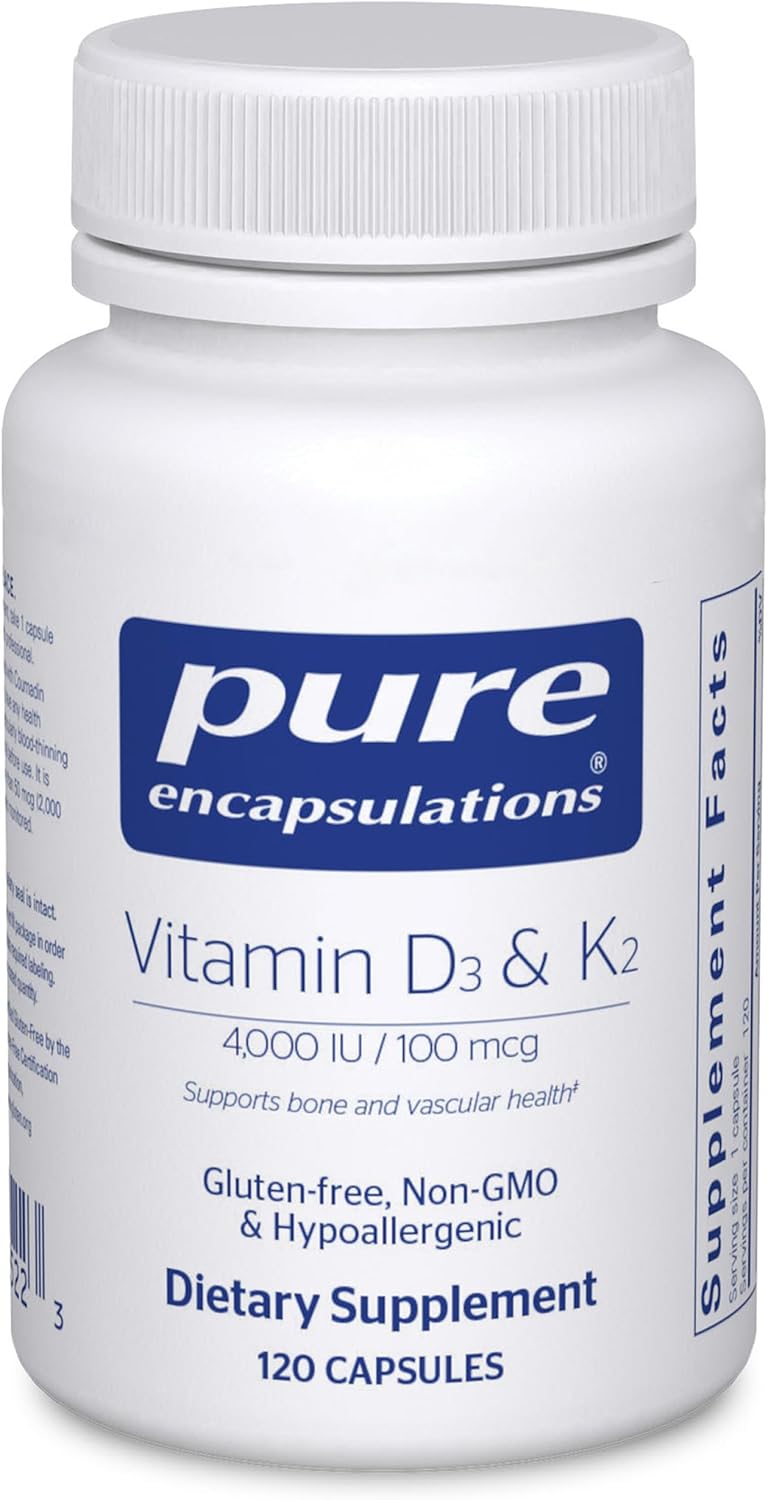
Pure Encapsulations D3 & K2
5,000 IU D3 + 180mcg MK-7 K2 · 60 capsules · ~2 month supply
$35.50
Check Price on Amazon →What About Magnesium?
There's a third piece that often gets overlooked: Magnesium is required for D3 to be converted into its active form. Without adequate Magnesium, D3 supplementation may not work as intended. Many Americans are low in Magnesium, which means their D3 conversion is inefficient regardless of how much they're taking.
If you're building a longevity foundation, the full trio is D3 + K2 + Magnesium. The D3 and Magnesium work as cofactors, and K2 directs the calcium that D3 mobilizes. Three supplements, one coherent system. The longevity stack guide covers how these fit into the broader stack.
Not medical advice
If you're on warfarin or other anticoagulants, consult your doctor before adding K2. For everyone else, standard doses of K2 (100-200mcg MK-7) are considered safe and well-tolerated. Get your 25(OH)D tested before and after starting D3 supplementation to dial in your dose.
Frequently Asked Questions
Can we take Vitamin D3 without K2?
Technically yes, but it's not advisable at higher doses long-term. D3 significantly increases calcium absorption. Without K2 (MK-7), that calcium can deposit in arterial walls rather than being directed to bones. At doses of 2,000 IU or more taken daily, pairing with K2 is strongly recommended.
How much D3 and K2 should we take?
Most adults benefit from 2,000 to 5,000 IU of D3 daily depending on sun exposure and baseline blood levels. A 25(OH)D blood test will tell you exactly where you are. For K2, 100 to 200mcg of MK-7 is the standard dose. Pure Encapsulations D3 & K2 provides 5,000 IU D3 and 180mcg MK-7 in one capsule.
What is the difference between K1 and K2?
Vitamin K1 is involved primarily in blood clotting and is found in leafy greens. Vitamin K2 (MK-7 form) has a much longer half-life and is specifically responsible for activating proteins that direct calcium into bones and away from arteries. For cardiovascular and bone longevity, K2 as MK-7 is what you need.