We picked up Dr. David Sinclair's Lifespan as a team read, and it changed how several of us thought about aging. His case for the sirtuin pathway - and the role resveratrol plays in activating it - is one of the most coherent frameworks we've encountered in the longevity literature. This is what we found when we looked at the evidence behind his personal protocol.
Quick Answer: What Resveratrol Does
- Activates SIRT1 - the "longevity gene" that governs cellular repair, inflammation, and metabolic efficiency.
- Mimics caloric restriction - triggers the same stress-response pathways as fasting and exercise without the actual deprivation.
- Dose matters enormously - most supplements are 50-150mg. Research doses run 500-1,500mg. You need the higher end to see the effect.
- Fat required - resveratrol is fat-soluble. Without a fat source, bioavailability drops by up to 90%.
- Works best stacked - pairs with NAD+ precursors (NR/NMN) for a synergistic effect on the sirtuin pathway.
The Sinclair Theory of Aging - and Where Resveratrol Fits
Sinclair's information theory of aging goes like this: your DNA is like a master hard drive. Every cell has an identical copy of your genome, but each cell type expresses different genes - that's what makes a liver cell different from a neuron. The system that controls this gene expression is called the epigenome, and it relies heavily on a family of proteins called sirtuins.
Sirtuins are your cellular maintenance crew. When they're fully active, they repair DNA damage, suppress inflammation, regulate metabolism, and essentially keep your cells running like newer hardware. The problem is that sirtuins require NAD+ to function, and NAD+ levels drop by roughly 50% between your twenties and fifties. As NAD+ depletes, sirtuins slow down, epigenetic maintenance degrades, and cells start expressing the wrong genes at the wrong times. That's aging at the molecular level.
Resveratrol enters the picture because it's a direct sirtuin activator - specifically SIRT1. It binds to SIRT1 and increases its activity independently of NAD+ levels. Think of it as a second switch on the same circuit. You're boosting SIRT1 from two directions at once: resveratrol activates it directly, NAD+ precursors give it the fuel to run. That's why Sinclair pairs resveratrol with NMN (or NR) in his personal stack. Separately they help. Together they compound.
The Dose Problem Most People Don't Know About
Here's where most resveratrol supplements quietly fail. Walk into any health food store and you'll find bottles of 50mg, 100mg, 150mg resveratrol. Those doses look fine on a label. They do almost nothing at the biological level.
The studies that produced meaningful results - including the early Harvard research that put resveratrol on the map - used doses in the range of 500mg to 2,500mg. A 2010 clinical trial published in Cell Metabolism used 150mg and found metabolic improvements, but subsequent research pointed to higher doses for more pronounced effects on inflammation, mitochondrial function, and cardiovascular markers.
Sinclair takes 1,000mg (1 gram) daily. That's 7-20x what most retail supplements provide. At 50mg, you're not activating sirtuins in any meaningful way. You're essentially buying expensive placebo.
This is why the dose on Biodora Resveratrol caught our attention: 1,600mg per serving. That's legitimately in the range where the research operates.
The Bioavailability Problem - and How to Solve It
The other issue with resveratrol that almost nobody mentions at the point of sale: it's fat-soluble and has notoriously poor oral bioavailability in isolation. Studies have found that plain resveratrol powder has roughly 1% oral bioavailability when taken on an empty stomach. Most of what you swallow gets degraded before it reaches circulation.
The fix is straightforward but non-negotiable: take it with fat. A tablespoon of olive oil, half an avocado, a spoonful of full-fat yogurt. Sinclair specifically mentions this in his protocol - he mixes his resveratrol with yogurt every morning. Fat dramatically improves absorption, pushing bioavailability from near-zero to something clinically relevant.
Piperine (black pepper extract) also enhances resveratrol absorption by inhibiting the liver enzyme that breaks it down. Some formulations include it for exactly this reason.
| Condition | Estimated Bioavailability |
|---|---|
| Standard capsule, empty stomach | ~1% |
| Standard capsule, with fat | ~30-40% |
| With fat + piperine | ~50-60% |
| Pterostilbene (methylated analog) | ~80% (inherently) |
What You Actually Notice: The Subjective Experience
We want to be careful here because supplement experiences are genuinely variable, and anyone claiming a specific feeling from resveratrol within a week is either running a placebo or conflating other factors. That said, after 6-8 weeks on a consistent high-dose protocol, most people report a consistent cluster of changes:
- Energy steadiness - not a stimulant spike, but fewer afternoon drops and a more even baseline throughout the day. This is consistent with AMPK activation improving mitochondrial efficiency.
- Faster recovery - after workouts, after late nights, after illness. The anti-inflammatory mechanism of SIRT1 activation appears to speed tissue repair.
- Skin quality - this one surprises people. Resveratrol activates SIRT1, which regulates collagen gene expression and suppresses inflammatory cytokines that degrade skin. Several clinical trials have shown measurable skin improvements with oral resveratrol supplementation.
- Sharper mornings - many long-term users report that the vague cognitive fog of getting older improves. Resveratrol crosses the blood-brain barrier and has documented neuroprotective effects in animal models and early human trials.
None of this is overnight. Resveratrol is not a stimulant and doesn't produce an immediate effect. It's a molecule that works on gene expression over weeks and months. Think of it less like coffee and more like consistent training - the results compound slowly and then feel normal until you stop.
What Sinclair's Own Numbers Show
Sinclair has been publicly open about his own biological age testing. He's in his mid-50s chronologically. His biological age, measured via epigenetic clocks (the most validated aging biomarker we currently have), has consistently tested significantly younger. He attributes this to a stack that includes resveratrol, NMN, metformin (prescription), and several other compounds, alongside intermittent fasting and regular exercise.
He's careful to say he can't attribute any single result to any single compound. But he also doesn't hedge on the mechanism: the sirtuin pathway is the most robust longevity pathway identified in the research, resveratrol is the most studied natural sirtuin activator, and the dose and bioavailability points he raises are consistent with everything the research literature shows.
What we take from that is straightforward: if someone with this level of expertise in the field chooses to take it at 1g daily for a decade, the prior probability that it does something useful is high. Not guaranteed. High.
The Right Resveratrol: Why Dose and Brand Matter
The Biodora Resveratrol 1600mg Complex is the formulation we recommend because it solves both problems at once: the dose is high enough to matter (1,600mg versus the 50-150mg in most products), and it's a complex rather than a single molecule. At $39.99 for 180 capsules, it's genuinely good value for the dose you're getting.
One thing worth mentioning: resveratrol degrades quickly when exposed to light and air. Look for products in dark or opaque bottles. Store in a cool, dry place. The difference between a well-stored and a poorly stored resveratrol supplement can be significant in terms of actual active compound remaining.
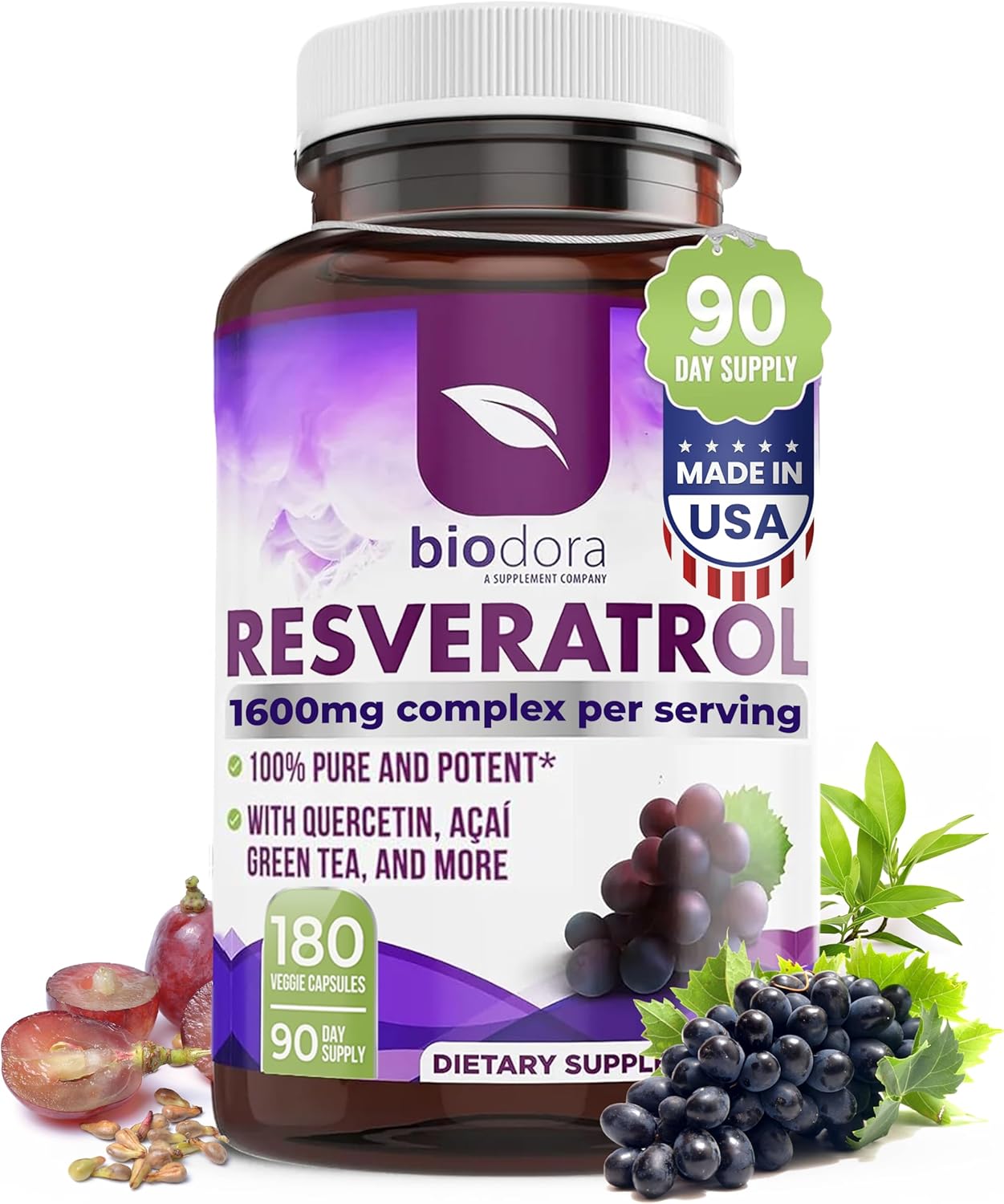
Biodora Resveratrol 1600mg Complex
1,600mg trans-Resveratrol per serving · 180 capsules
$39.99
Check Price on Amazon →How to Stack It
Resveratrol works best as part of a system, not in isolation. Here's the stack that makes the most sense based on the research:
- Resveratrol (1,000-1,600mg) + fat - take with breakfast or any meal containing fat. This is the sirtuin activator.
- NR or NMN + TMG - the NAD+ precursor fuels the sirtuins that resveratrol activates. TMG supports the methylation that NR/NMN consumes. These three together are the core of what Sinclair's protocol is built around.
- Pterostilbene - the methylated cousin of resveratrol with better inherent bioavailability. Some people take both; others rotate. Either works. Together they cover the sirtuin activation pathway more thoroughly.
The full stack - resveratrol, NR, TMG, and Pterostilbene - runs about $155-170/month. For what it targets (the most validated longevity pathway in the research literature), that's a reasonable number.
Sinclair's Morning Protocol (as described publicly)
1g NMN + 1g Resveratrol mixed into yogurt, taken in the morning. He skips breakfast most days (intermittent fasting) but takes these compounds with the yogurt as the fat carrier. He's mentioned that he stores his resveratrol in the fridge to preserve potency. These are his personal choices - not medical advice - but the protocol has a clear mechanistic logic behind each element.
What Resveratrol Won't Do
Honest caveat: resveratrol is not going to undo decades of poor sleep, a bad diet, or a sedentary lifestyle in a bottle. Sinclair is emphatic about this in Lifespan - the supplements work on top of the lifestyle fundamentals, not instead of them. His personal protocol includes consistent exercise, intermittent fasting, and what he describes as a mostly plant-based diet. The supplements are precision optimization on a base that's already solid.
If you're starting from zero, sleep and exercise will move your biological age markers faster than any supplement. But once those boxes are reasonably checked, the sirtuin pathway is the highest-leverage place to focus supplementally. And resveratrol - at the right dose - is still the most studied tool for activating it.
Frequently Asked Questions
What does Dr. David Sinclair say about resveratrol?
Dr. Sinclair, professor of genetics at Harvard Medical School, has publicly stated that he takes 1 gram of resveratrol daily, mixed with a small amount of fat to improve absorption. He views it as a sirtuin activator that mimics the cellular stress signals produced by caloric restriction. His 2019 book Lifespan brought resveratrol from niche supplement to mainstream longevity conversation.
How much resveratrol should we take per day?
Most longevity researchers work with doses between 500mg and 1,500mg. Standard over-the-counter supplements are often 50-150mg, which is well below what the research uses. Biodora Resveratrol provides 1,600mg per serving - in line with the high end of the research doses. Always take it with a fat source to maximize absorption.
Does resveratrol actually make you feel younger?
Many people report improvements in energy steadiness, recovery speed, and skin quality within 4-8 weeks of consistent high-dose supplementation. These effects align with SIRT1 activation, AMPK pathway engagement, and anti-inflammatory effects on gene expression. Individual responses vary, and it works best as part of a broader longevity stack.